

Distinguish a manufacturing location from a service contact.
Sunshine's address page lists Shenzhen and Jiujiang operations, alongside Germany, the United States and Penang, Malaysia. A contact in one region does not identify which site will produce your design. Ask the quotation to name the manufacturing entity and location, especially if qualification or origin requirements attach to a particular plant.
The 2025 annual report filed on CNINFO identifies 深圳明阳电路科技股份有限公司 and separately defines Jiujiang, German, US and Malaysian subsidiaries. It provides corporate context, rather than independent validation of the process-table figures below.
High-speed routing is not the same problem as heavy copper.
AI and data-centre construction
In this table, Standard outer line/space is 3.5/3.5 mil and Advanced is 3.0/3.5 mil. Inner-layer values distinguish 1 oz from half-ounce copper: the Advanced half-ounce row is 2.5/2.5 mil. Quoting that finer inner-layer value as an outer-layer limit would lose the copper and layer conditions.
The listed 7 mil minimum drill hole is a drilling entry, not a finished plated-hole guarantee. The table also distinguishes backdrill stub, registration and test bandwidth. If signal loss is important, specify the measurement method and frequency range rather than relying on the presence of a high-speed product label.
Backplanes and line cards
The data-communications table gives backplane layer ceilings of 60 Standard / 70 Advanced, versus 42 / 62 for line cards. Its maximum dimension is 1200 × 680 mm in both columns. Separate this application from the AI table when requesting a large backplane; panel size, registration, connector-hole tolerance and backdrill requirements need to be reviewed together.
Thermal management and high current
The thermal table lists 15 oz Standard / 30 oz Advanced inner copper, with routing rows changing by copper weight: 2 oz uses 6/6 mil Standard and 5.5/5.5 mil Advanced; 6 oz uses 14/14 and 13/13 mil. These rows explain why a heavy-current board cannot borrow a fine-routing limit from the half-ounce high-speed table.
Embedded copper coins, thick plated holes, metal bases and localized thick copper appear as separate thermal approaches. Choose the required heat path and electrical construction first, then ask which process can support it and what dimensional tolerances apply.
The product examples make the conditions concrete.
Sunshine's AI/data-centre catalogue identifies the following constructions individually. The general process table remains a separate source: a pictured board does not inherit every value in its Advanced column.
Twenty-eight impedance groups at the example's stated tolerance
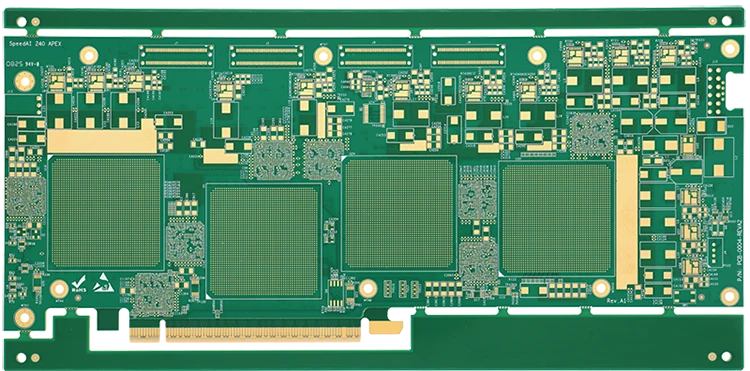
The 26-layer acceleration card is labelled “7 Steps HDI”. Its own entry gives 28 impedance groups with ±10% tolerance. That is the applicable published example value here; the generic table's conditional ±5% row is not substituted.
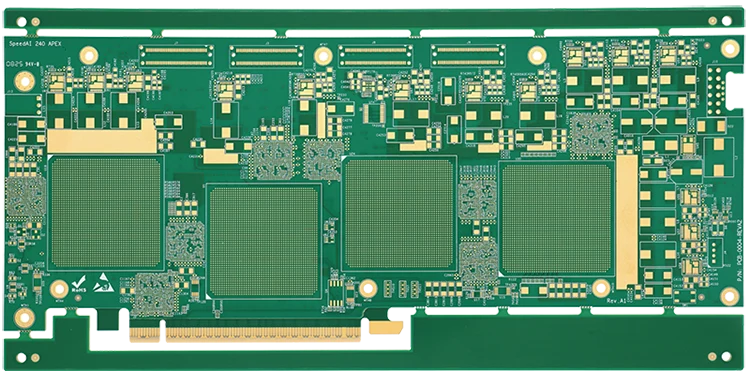
- Layers / catalogue HDI label
- 26 / 7 Steps
- Laminate
- EMC EM-890K
- Microvia, catalogue value
- 0.1 mm
- Impedance groups / tolerance
- 28 / ±10%
- Finish and contact features
- ENIG + gold fingers
Request the build-up drawing: ask how the seven steps map to lamination and via structure, which nets belong to each impedance group, and what coupon measurements are supplied. Include the stepped-finger dimensions and any decapping requirements in the drawing.
Ten backdrill depths need a depth map
The heterogeneous-computing server example uses 20 layers, ENIG and backdrilling. It names ten different backdrill depths and a 19:1 aspect ratio. The entry does not identify the aperture or thickness pair behind that ratio.
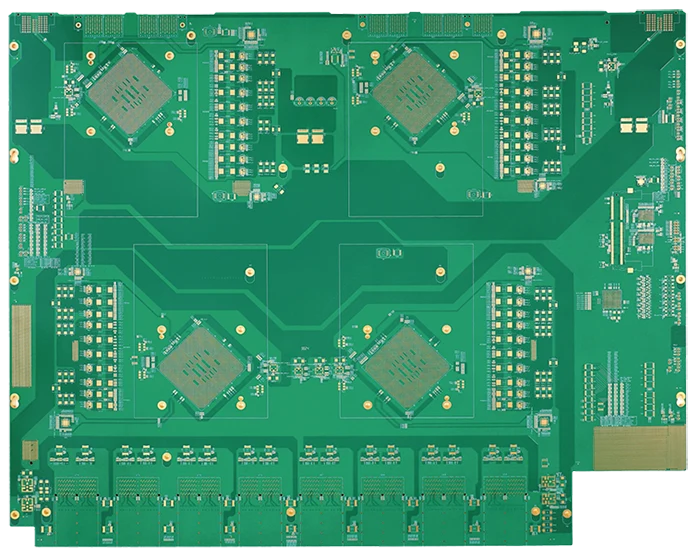
- Layers
- 20
- Laminate, catalogue wording
- Panasonic R-5785(GN)
- Finish
- ENIG
- Different backdrill depths
- 10
- Aspect ratio
- 19:1
Send a depth-controlled drill map: identify entry side, start/stop layers, residual-stub limits, drill clearances and the required verification method. Ask the engineering reply to define the hole and thickness used for the aspect ratio instead of inferring them from the picture.
Thick copper and an 8.4 mm construction
The planar-transformer entry gives 16 layers, 6 oz heavy copper, TUC TU-865 and an 8.4 mm board. This is a specific catalogue construction. The AI process table's separate 8 mm Advanced maximum is not rewritten to match it; confirm which process route applies to the proposed transformer.
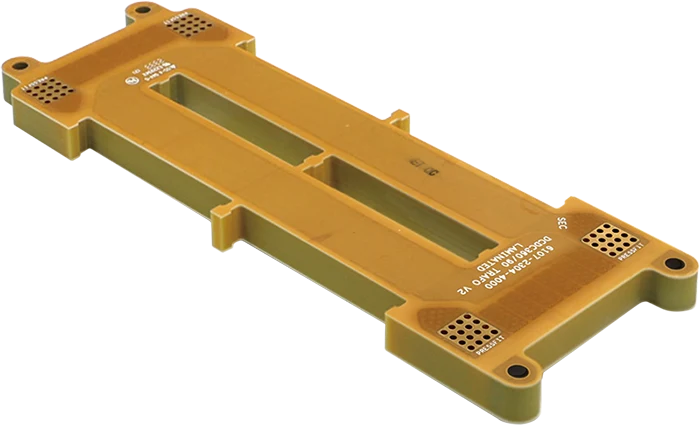
- Layers
- 16
- Board thickness
- 8.4 mm
- Heavy-copper entry
- 6 oz
- Laminate
- TUC TU-865
- Machining feature
- Depth-controlled drilling
Define the insulation and copper by layer: provide working voltage, required isolation test, drawing clearances and machining depths. Ask whether 6 oz applies to all layers or selected conductors, and which thickness/copper tolerances are quoted.
The equipment list also reveals a handoff.
Sunshine's equipment page names mechanical and laser drilling, laser direct imaging, AOI, flying-probe testing and reliability-test equipment. It lists a Hitachi laser drill and Orbotech LDI equipment. These are manufacturer disclosures of a process route, not an inspection of installed machines or proof that a particular line will make your order.
Immersion silver is listed as subcontracted
The surface-finish row explicitly identifies immersion silver as “Sub-contract.” If your build needs that finish, ask who performs it, how lots are tracked across the handoff and which finish measurements and acceptance reports are included. Do not assume every listed process is performed at the quoted factory.
For laser vias, request the build-up drawing and the intended process site. For controlled impedance, request the coupon and measurement plan. The equipment list can guide these questions, while the order-specific manufacturing plan supplies the answer.
Ask for a marked-up process table.
- Name the application and columnIdentify AI/data centre, backplane, thermal/high-current or industrial control. Ask whether the proposed complete build belongs in Standard or requires Advanced review.
- Define copper and signal requirementsGive copper by layer, outer/inner routing, laminate grade, via stack, impedance nets and any loss-test requirements. Keep drilling and finished-hole sizes separate.
- Identify the site and external processesRequest the production location, finishing route, subcontractor controls and order-specific inspection reports. Include permitted material or process substitutions.
Sources behind this profile
Technical pages and address directory rechecked on 8 October 2026. The annual report is an issuer disclosure hosted on CNINFO, not a factory audit. Figures retain their table, column and copper conditions; the combined build needs an engineering quotation.
- MANUFACTURER / PRODUCT EXAMPLESNamed acceleration-card, server and planar-transformer constructions ↗
- MANUFACTURER / PROCESSApplication tables with Standard / Advanced columns ↗
- MANUFACTURER / EQUIPMENTEquipment and subcontracted immersion-silver disclosure ↗
- MANUFACTURER / LOCATIONSContact and site address directory ↗
- REGULATORY FILING / COMPANY2025 annual report, filed April 2026 (PDF) ↗