Start with the substrate, then agree the production column.
Haiying Electronics (四川海英电子科技有限公司) identifies its manufacturing location as 317 Mingxing Avenue, Suining, Sichuan. The current official company introduction dates the company to 2006 and reports 38,600 m² of standard factory buildings. It lists double-sided, multilayer, HDI, metal-base and rigid-flex work. Those are company-level disclosures; the more useful starting point for an order is its named material family and the intended sample-to-volume route.
Haiying’s product catalogue separates conventional laminate boards, metal-base boards and higher-layer PCBs. Its manufacturing page distinguishes Mass Production from Prototype, then supplies an additional processing table with different limits. The selections below keep product material descriptions apart from those general process tables. They do not assign every maximum to a pictured board.
GLASS / EPOXY ROUTE
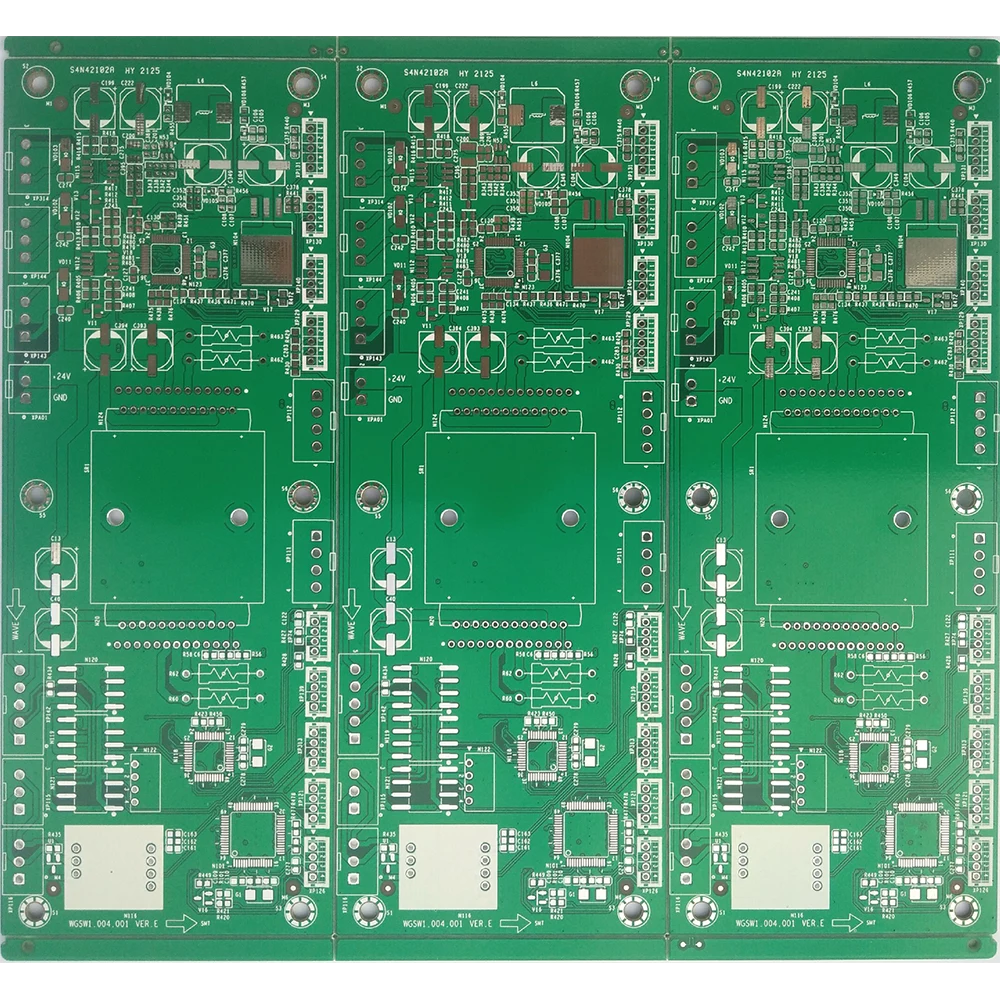
Double-sided and multilayer FR-4
Original FR-4 product photograph · The photograph is not a dimensional drawing.
Listed base thicknesses
0.8 · 1.0 · 1.2 · 1.6 · 2.0 mm
Listed copper-foil thicknesses
18 · 35 · 70 μm
Listed surface processes
HASL · electroplated gold · OSP
The detail page gives base-material choices and a 1044 × 1245 mm sheet size. These are not finished multilayer-board thicknesses or an accepted PCB outline. Name the laminate manufacturer and grade, final stack thickness and finished copper in the inquiry. Do not substitute a base-foil value for the copper after plating.
COMPOSITE LAMINATE ROUTE
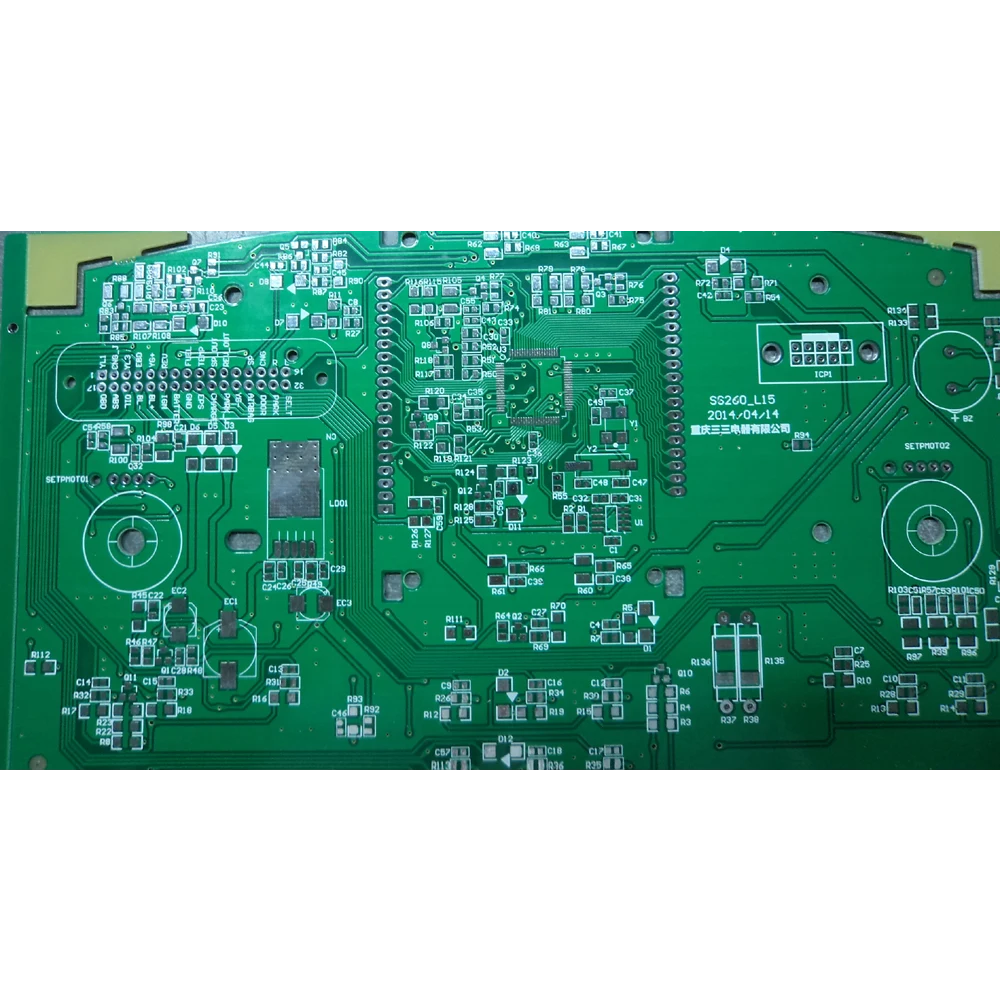
CEM-3 needs its own material approval
Original CEM-3 catalogue photograph · Material approval belongs to the actual purchase specification.
Listed base thicknesses
1.0 · 1.5 mm
Listed copper foil
35 μm
Listed surface processes
HASL · electroplated gold · OSP
The source describes CEM-3 separately from FR-4 and notes differences in bending strength and thermal expansion. Treat a substitution as an engineering decision. Request the proposed grade’s data sheet, applicable safety listing, PTH qualification and the assembly thermal exposure accepted for your construction. Generic material comparisons on the page are not lot-specific test reports.
PROCESS COLUMNS / QUOTATION BASIS
Keep the prototype quote and the volume release separate.
The following values come from the same explicitly labelled process table. Its limits describe a general route; an accepted stack, copper weight and geometry still need to be reviewed together.
MASS PRODUCTION
12 layers · 4 / 4 mil
Board thickness
0.4–4.0 mm
Inner / outer copper maxima
4 oz / 5 oz
Aspect ratio
6:1
Impedance control
±10%
Immersion-gold deposits
Ni 2–5 μm · Au 0.05–0.10 μm
PROTOTYPE
18 layers · 3 / 3 mil
Board thickness as written
Below 0.4 mm or above 4.0 mm
Inner / outer copper maxima
5 oz / 5 oz
Aspect ratio
10:1
Impedance control
±5%
Immersion-gold deposits
Ni 3–6 μm · Au 0.075–0.15 μm
For a sample that must later enter volume production, ask which prototype exceptions remain acceptable at volume, and which require a redesign or a separate process qualification. In particular, the 18-layer sample column is not a promise of 18-layer volume production. The prototype thickness row is written as an exception outside the mass-production range; it does not supply an unlimited thin/thick-board range.
Hole definitions and the second processing table
The first table labels minimum drill holes separately from laser holes. Its mass-production values are 8 mil / 0.2 mm for drilling and 4 mil / 0.1 mm for laser holes. Its prototype drill entry says “6 mil / 0.1 mm”, an inconsistent unit pair. We do not silently choose one value, convert it into a finished-hole minimum or include it in a numerical filter.
The additional processing table lists 1–16 layers, a 500 × 800 mm maximum, 0.20–6.00 mm board thickness and an 8:1 aspect ratio. It explicitly separates mechanical drilling at 0.20–6.35 mm from finished holes at 0.15–6.30 mm. Its outer-copper row is printed “35–175 mm”, while the inner row uses μm. These differences require a factory-confirmed process basis. They are not merged with the mass/sample table’s 20 × 48 inch size or 6:1 / 10:1 ratios.
State drill and finished-hole dimensions separately, including plating and tolerance. Request the applicable table revision, copper-conditioned routing and the approved dimensions for the actual panel. A minimum stated in a second table does not change the limits attached to your accepted quotation.
METAL BASE / THERMAL HANDOFF
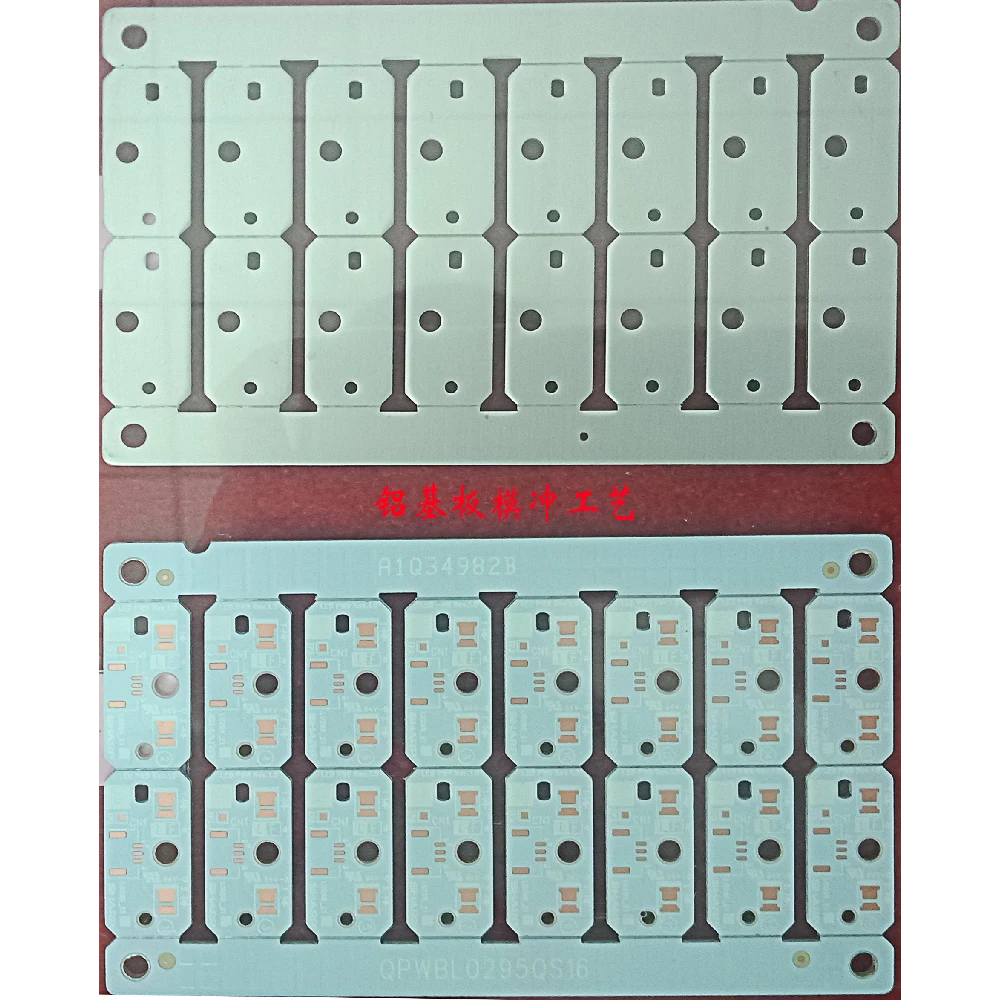
A single-sided aluminium board needs a thermal and mechanical brief.
Single-sided aluminium-base product · Original photograph and its annotation retained.
Listed metal-base thicknesses
1.0 · 1.2 · 1.6 · 2.0 · 4.0 mm
Listed copper foil
35 · 70 · 105 μm
Material sheet sizes
500 × 1200 · 600 × 1200 · 1000 × 1200 mm
Detail-page surface processes
Rosin · HASL
These are catalogue material choices, not a specified dielectric thermal conductivity or an approved finished-board outline. The manufacturer describes power and LED applications but provides no grade-specific dielectric thickness, thermal impedance, insulation withstand or allowable operating temperature for this photographed example.
Provide the component heat load, mounting geometry and intended interface to the enclosure or cooling system. Ask for the proposed metal alloy, insulation material, dielectric thickness, electrical isolation and thermal-test basis. Include burr/edge requirements, mounting-hole tolerances and whether punching or routing is accepted. The catalogue’s broad statement about avoiding a heat sink is not a substitute for the assembly’s thermal assessment.
HIGHER LAYERS / SAMPLE TRANSFER
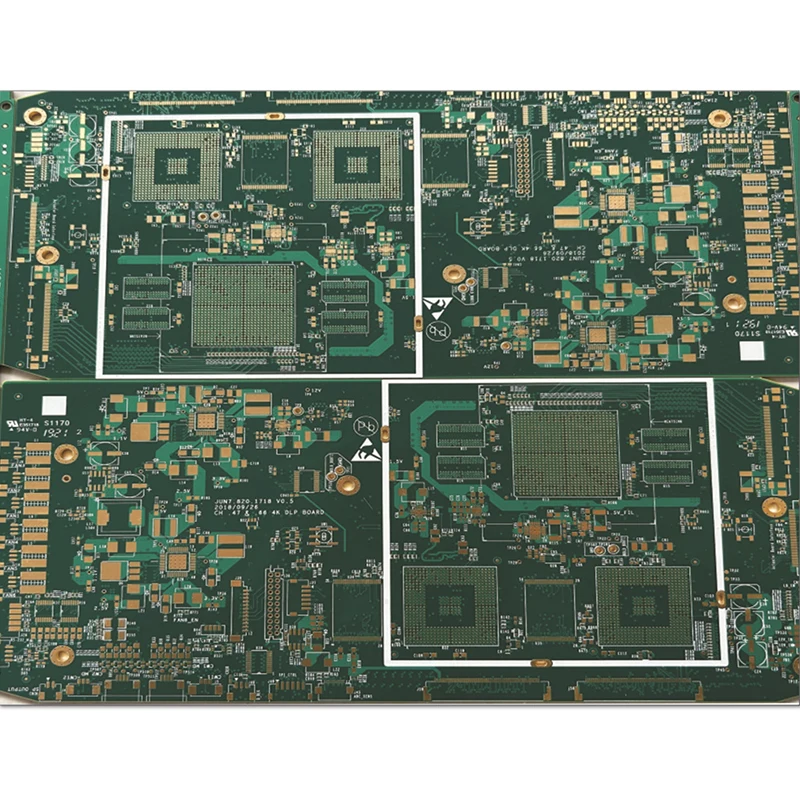
The 14-layer catalogue board is a separate engineering discussion.
The product title identifies fourteen layers, but its detail text is a general multilayer-design explanation. It does not give this board’s laminate grade, finished thickness, hole construction, impedance tolerance or copper weights. Neither the board image nor the generic discussion establishes those values.
Because fourteen layers exceeds the twelve-layer mass-production row above, ask which current route and qualification support the proposed volume. Start with the layer stack, signal layers and reference planes, finished-hole table, quantities and required acceptance reports. Request the routing/lamination review for that stack and a documented sample-to-volume handoff; do not assume that a product gallery entry resolves the process-table difference.
PROCESS CHAIN / RELEASE RECORDS
Turn the equipment list into the right inspection request.
Drilling and lamination
The manufacturer’s numbered list names CNC drilling entries D5L18E / H-MARK-10D, a vacuum/multilayer press MHKV100/10/6 and CNC milling entries NR-4C18E / H-NARK-90. Ask for hole registration, the accepted lamination build and the applicable dimensional report. The disclosed laser photoplotter is not proof of laser drilling.
Imaging and electrical test
The company introduction names LDI exposure, inline AOI and four-wire low-resistance testing. The numbered list separately names an AOI PL-1450 and bare-board testers LM-05, MPP406-HV and MPP4220/20. Obtain the test method, coverage, netlist revision and limits selected for the order, rather than inferring its electrical release from an equipment name.
Reliability and compliance
The list includes a humidity chamber and temperature-shock system. Agree the exposure and pass criteria for your material/assembly, with lot traceability. The official introduction names quality, automotive, environmental and product approvals; use the current certificate’s entity, site, scope and validity for the contract. No independent approval badge is assigned here from those company statements.
The contact page gives hypcb@haiyingchina.com.cn and 0825-5819767 at the same Mingxing Avenue address. These are published contact details, not a delivery test. For an inquiry, combine the chosen material family with the intended sample/volume process basis and the drawing-specific exceptions you want resolved. Request the accepted fabrication revision and release documents in the same response.
Official pages individually read on 8 October 2026. Product choices, mass/sample limits and the additional processing table retain their different scopes. Independent government-document review remains pending because the original document endpoints did not return during this review.