Shanghai YKC’s catalogue is especially useful when a buying brief begins with an application: industrial controls, automotive electronics or microwave communication. The company describes its establishment in December 1992 and double-sided and multilayer PCB manufacture at 388 Huacai Road in Qingpu, Shanghai. Its automotive gallery separates switches, fuse boxes, instrument panels, radar, motor controls and lighting; these are different release problems, not interchangeable examples of a maximum-layer board.
Start with the closest construction below. Each photograph keeps its own manufacturer label. The catalogue does not attach a layer stack, finished-hole diameter or line/space minimum to these entries; those belong in the drawing and the factory’s returned engineering proposal.
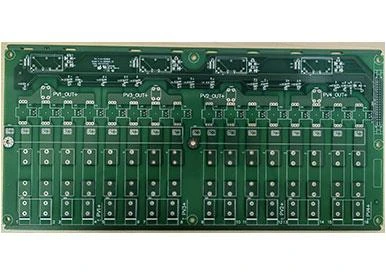
Industrial control — original catalogue application label.
Control boards: release the connector and mounting datums.
Send the stack proposal, connector drawings, mounting tolerances, electrical clearances and intended operating environment. Agree how continuity, finish and board identification will be recorded for each lot. The industrial gallery contains several layouts under the same label; it does not supply a model-specific performance specification.
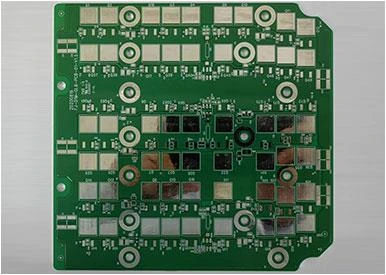
Motor drive control (aluminium base), automotive catalogue.
Motor control: define the metal and insulation together.
The manufacturer explicitly names an aluminium base. Ask for the base thickness, dielectric construction, insulation test and attachment to the intended heat sink. Define copper requirements and power-component mounting from your design. Neither a motor-control application label nor this photograph establishes a current or thermal-resistance rating.
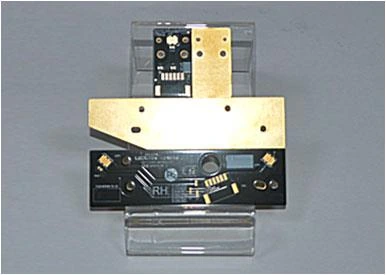
Car lighting (copper base), separately labelled from other lighting boards.
Lighting: keep the specified copper-base heat path.
Release the copper-base and dielectric stack, light-source attachment, flatness and connector interface. Agree insulation and thermal acceptance in the finished assembly. The neighbouring generic car-light examples do not establish the same base construction, and an aluminium substitution needs engineering approval.
RADAR / MIXED DIELECTRICS / PTFE
Turn a microwave catalogue label into a defined stack.
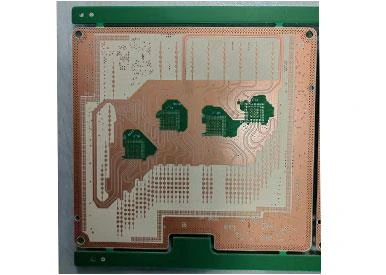
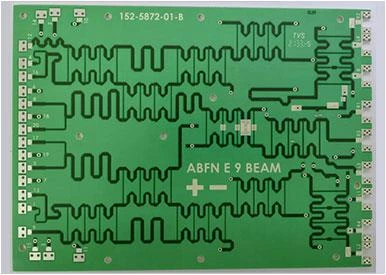
Millimetre-wave radar, automotive gallery.
Radar
Specify the operating band, laminate grade, copper and launch geometry. Ask how the proposed process controls the features that affect the antenna or transmission line and which RF measurements are included. The catalogue does not state frequency, insertion loss or antenna performance for this board.
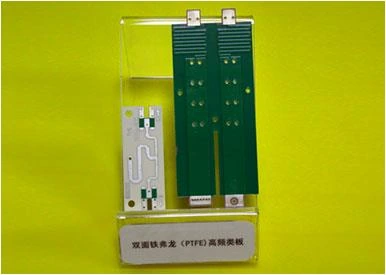
Get an actual stack drawing with material manufacturer, grade, thickness and bondply. The material-management chart also groups Rogers and Shengyi under a “ceramic” heading. That wording does not by itself prove a fired-ceramic substrate; resolve the dielectric composition and bonding process before comparing quotations.
Specify the exact grade rather than a generic material family. Agree hole preparation, plating, stack bonding and dimensional control for that grade. Define impedance or RF acceptance, coupon geometry and the measurement method. No Dk, loss, frequency or finished-hole minimum is inferred from the photo.
Material-change approval is part of the order.
YKC’s published policy calls for customer notification and approval of 4M changes — people, equipment, materials and methods — and material certificates by batch. Its named suppliers include Shengyi, Nanya, ITEQ, Panasonic and Kingboard for FR-4/CEM-3 families, Taconic in its Teflon category, Ventec for metal-base material and Taiyo for solder mask. These are manufacturer-listed supply routes; the page does not provide your order’s grade, lot certificate or authorised-distributor proof.
Ask the quotation to identify approved grades and substitutions, incoming-lot records and the change-notification procedure. A batch document matching the delivered board is more useful than a catalogue brand list.
PUBLISHED WINDOWS / YEAR AND STARTING CONDITION
Two annual columns, plus a separate delivery clock.
The official capability image labels its columns 2024 and 2025. They are not labelled prototype and volume production. Obtain a current confirmed process window; the image does not establish that every 2025 figure can be combined in one construction.
2024 column
Maximum layers / thickness
14 layers / 4.0 mm
Minimum board thickness
0.4 mm
Inner and outer line / space
0.075 / 0.075 mm
Maximum copper
5 oz
Impedance tolerance
±10%
Board thickness / hole diameter
10:1
2025 column
Maximum layers / thickness
18 layers / 4.5 mm
Minimum board thickness
0.3 mm
Inner and outer line / space
0.050 / 0.050 mm
Maximum copper
6 oz
Impedance tolerance
±8%
Board thickness / hole diameter
12:1
Both columns give a 0.15 mm minimum machining/drilling hole, ±0.025 mm drill-diameter tolerance, a 700 × 630 mm processing size and a 609 × 457 mm product size. A machining-hole entry is not a confirmed finished plated-hole size. The pad and insulation rows use “Drill +” notation; ask for its diameter definition rather than interpreting it as a radial annular ring.
Delivery starts after materials arrive.
The separate production-features chart explicitly makes its lead times conditional on material arrival. It describes varied products and small-to-medium lots, from one board to 1,000 m² per lot. Confirm whether the published “days” are working or calendar days, and when engineering approval and test preparation are complete.
These are published scheduling categories, not a delivery promise for a mixed-laminate, metal-base or radar order. The chart lists OSP, HASL, immersion gold, gold plating and immersion tin. Agree the finish specification and zones with the construction rather than assuming all routes share the same schedule.
DEFECT CONTAINMENT / THREE DIFFERENT QUESTIONS
Ask what was inspected, when, and against which limit.
YKC’s defect-detection chart describes hole inspection before plating, online AOI for inner and outer layers, hole inspection after HASL, four-wire electrical testing and automatic visual inspection. These steps answer different questions; an AOI image is not a resistance test or an agreed appearance standard.
01 / Geometry
Before defects are buried
Ask which layers and holes receive inspection, how defects are dispositioned and whether the retained records identify the released artwork revision and manufacturing lot. The equipment gallery labels mechanical drilling, LDI, AOI and lamination equipment. A machine photo does not establish calibration or the assigned process recipe.
02 / Electrical
After the conductive structure is complete
Agree continuity, isolation and, where relevant, the four-wire resistance limits, test current, fixture and reporting. The gallery also shows open/short testing. Do not assume that a general electrical test supplies RF loss, insulation validation for a metal base or every application-specific acceptance result.
03 / Appearance
Before the lot is released
Define the finish, marking, mask and cosmetic acceptance, then request the agreed AVI results and any manual disposition. Match board identification, material batch and test records to the packing list. The equipment gallery includes VCP plating, solder-mask coating/exposure, lead-free HASL and CNC profiling.
For an initial build, request the inspection plan before fabrication and decide which records must accompany shipment. For repeat orders, define what triggers a requalification or customer change approval. This connects the factory’s published material-management policy to measurable purchasing requirements.
QINGPU SITE / DOCUMENT DATES
Match qualification documents to the Shanghai order.
The named company and address
The manufacturer contact page gives 上海山崎电路板有限公司 at 388 Huacai Road, Huaxin Town, Qingpu, Shanghai. A Qingpu District government employment notice dated 13 September 2024 independently names the same company, double-sided/multilayer PCB activity and the same address. It supports that dated identity and location; it is not a quality audit or proof of current process limits.
The current document to request
The website’s NQA image names Shanghai YKC and 388 Huacai Road, covers printed circuit board manufacture under IATF 16949:2016 and excludes product design. It shows NQA T182649, IATF 0501673, first issue 20 February 2024 and validity until 19 February 2027. Obtain the complete certificate, including its referenced locations appendix, and confirm current issuer status for the scope on your quotation.
The same gallery retains an older NSF-ISR IATF copy with printed expiry 5 April 2024. The ZDHY ISO 9001, ISO 14001 and ISO 45001 images show expiry 20 March 2023. They are historical website documents, not current certifications. This page does not issue an active issuer-verification or UL-ownership badge based on the gallery.
Choose a construction above and ask for a returned stack, named material grade, inspection plan and delivery start condition. Confirm the contracting legal entity and producing address on the quotation. For automotive supply, agree the qualification and change-control documents your programme requires; an application label alone is not programme approval.
SOURCE TRAIL
Sources behind this profile
Individually researched 8 October 2026. Manufacturer data and construction labels are distinguished from buyer release guidance. Original photos are complete and matched to their own entries. Annual capability columns are not relabelled batch/sample or assigned to the photographed boards. Document expiry and scope follow the readable copies; no factory audit, current issuer verification or delivery guarantee is implied.