

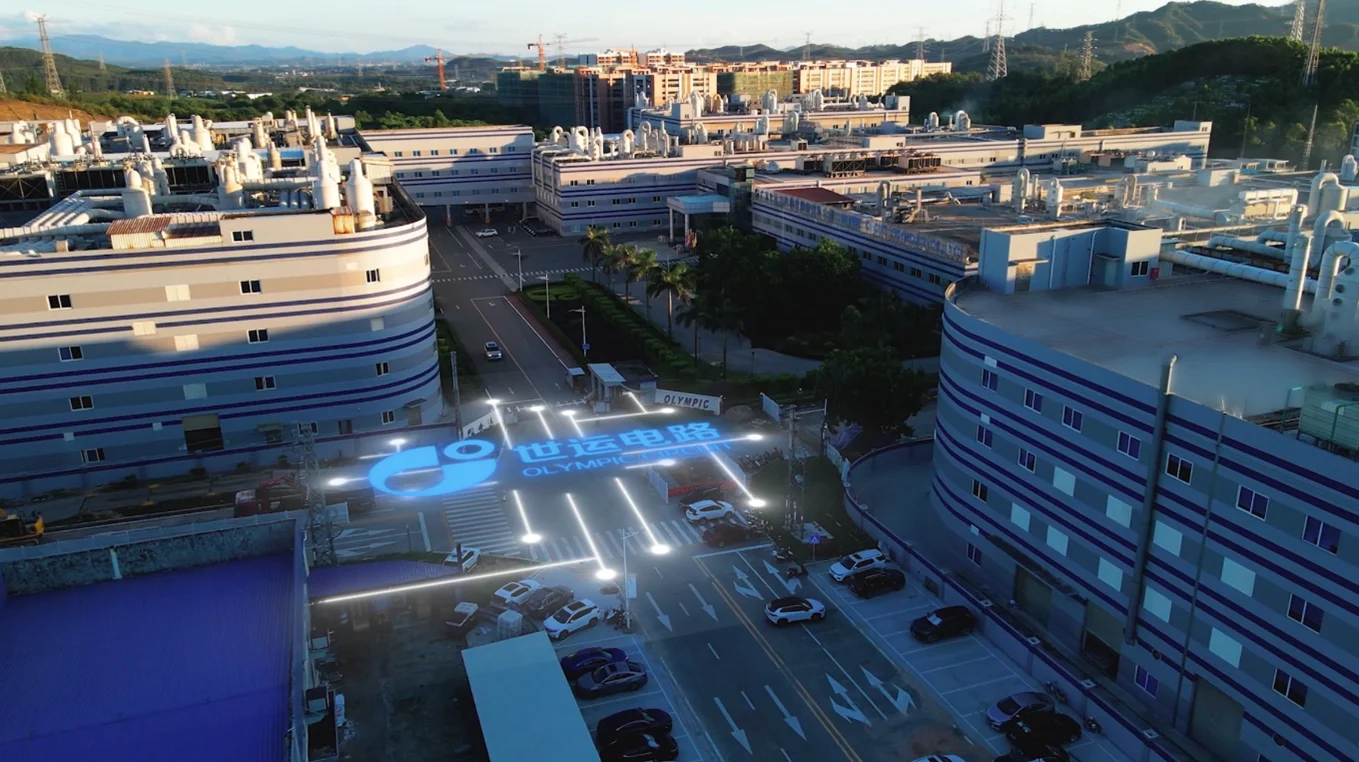
Identify who contracts and who manufactures.
The official site identifies 广东世运电路科技股份有限公司 and dates its origins to 1985. The footer lists Guangdong Olympic Circuit Technology and a Hong Kong Olympic contact, using the olympicpcb.com mailbox domain. Those are useful identity and contact clues, but a shared mailbox does not settle which entity will contract or which location will produce an order.
The 2026 half-year report identifies the registered and office address as No. 8 Shiyun Road, Gonghe Town, Heshan. Its production section distinguishes the adjacent Heshan plants of Olympic and Shian Electronics (世安电子) from Zhuhai’s flexible and rigid-flex production. It states that the Thailand plant in Chachoengsao had entered mass production during the reporting period. Ask which of these legal entities and sites the proposal uses.
The company introduction mixes historical milestones, capacity figures and customer names. This profile focuses on the sourcing decisions supported by the named board families; it does not present those dated scale claims as guaranteed current available capacity or reproduce customer names as endorsements of your proposed build.
Read the column for your board.
Olympic’s capability page separates high-layer rigid, HDI, flexible/rigid-flex and metal-base fabrication. The excerpts below keep that separation. A layer range and a minimum feature are different entries; their publication does not establish that all endpoints can be combined in one drawing.
Through-hole multilayers
- Layers / board thickness
- 1–24 / 0.3–3.4 mm
- Inner and outer line / space
- 0.05 / 0.05 mm
- Inner base / outer finished copper
- ⅓–6 oz / 1–5 oz
- Maximum finished dimensions
- 724 × 622 mm
For the drawing review: define the copper distribution, drill plan and controlled-impedance coupons. The named signal-integrity methods include SET2DIL, Delta-L and VNA; agree the measurement and acceptance that apply to the order.
Build-up and any-layer
- Layers / board thickness
- 4–24 / 0.27–3.4 mm
- Inner and outer line / space
- 0.05 / 0.05 mm
- Published structures
- 5+N+5; any-layer
- Microvia aspect ratio
- 1:1 maximum
For the drawing review: supply the complete build-up and via connectivity. Request the proposed dielectric, laser geometry and qualification plan; the laser-hole entry of ≥0.075 mm is separate from mechanical drilling.
Define the moving and rigid zones
- Layers
- FPC 1–8; rigid-flex 2–14
- Board thickness
- FPC 0.05–1.0 mm; rigid-flex 0.27–3.2 mm
- FPC inner / outer line and space
- 0.04 / 0.04 mm; 0.045 / 0.045 mm
- Rigid-flex inner and outer line / space
- 0.05 / 0.05 mm
For the drawing review: identify bend zones, static or dynamic use, stiffeners and assembly interfaces. The page lists symmetric, air-gap and asymmetric/HDI constructions; choose the stack and mechanical requirement before requesting a process release.
Copper or aluminium base
- Layers / board thickness
- 1–2 / 0.8–3.2 mm; typical 1.6 mm
- Outer line / space
- 0.10 / 0.10 mm
- Outer finished copper
- 1–2 oz
- Maximum finished dimensions
- 520 × 610 mm
For the drawing review: specify the thermal path, base metal, insulation and mounting. Keep metal-base limits separate from the multilayer and HDI columns, particularly for apertures and aspect ratio.
Three entries that need their original meaning
Drilling: ≥0.15 mm is labelled mechanical drill-bit diameter in the rigid, HDI and flex/rigid-flex columns. It is not a minimum finished-hole claim. Back drilling: ±3 mil is a depth-tolerance entry for those columns, not the residual stub. Impedance: the row says 8% for those columns; ask engineering to define the tolerance, coupon and report against your target.
Rogers, Panasonic, Isola, ITEQ, Shengyi and other suppliers appear in the shared rigid/HDI materials cell. Flex and metal-base have their own supplier cells. Put the exact laminate grade, thickness and substitution approval in the BOM; the website’s supplier list is not a lot-level material certificate.
Three application briefs, with different published ranges
Automotive electronics
The automotive page lists braking, steering, airbags, powertrain, inverter/DCDC/OBC, battery management, driver assistance and cockpit electronics. Its through-hole range is single-sided to 18 layers; other routes include HDI, any-layer, hybrid HF/RF, semi-flex, thick copper, metal-base, embedded copper, flex and rigid-flex.
Bring to the RFQ: the function, approved stack, site requirement and customer-specific qualification package. A power-conversion board and a radar or cockpit board need distinct material, electrical and reliability briefs.
Wind, solar and storage
The energy page names PCS converters, BMS, EMS and power optimisers. It lists through-hole boards up to 20 layers alongside HDI, mechanical blind holes, thick copper and metal-base construction.
Bring to the RFQ: operating voltage, thermal and insulation requirements, copper map and test plan. The published application range does not establish current rating, creepage or thermal performance for the design.
Cloud computing and communications
The computing page names servers, storage, accelerator and graphics cards, motherboards, expansion cards, connectors and routers. It lists through-hole boards up to 24 layers, HDI and stepped or segmented gold fingers.
Bring to the RFQ: the stack, material grade, insertion-loss or impedance requirements, connector geometry and inspection plan. Specify the gold-finger finish and dimensional acceptance instead of using the application name as a fabrication specification.
An automotive RFQ needs a change-control plan.
The official page describes automotive, industrial, consumer, computer/peripheral, communications and medical applications, with automotive emphasized. For a vehicle programme, define the required customer approval package and production location before negotiating a generic “automotive PCB” quotation.
Agree the evidence
Request the programme-specific qualification and acceptance documents, sampling plan and lot traceability. Specify any PPAP scope required by your customer.
Agree the change rules
Define approval before changes to laminate, process, manufacturing location or inspection. Ask how the supplier identifies and tracks the approved construction.
The manufacturer mentions ISO/IATF and safety approvals. Obtain the current certificate and its legal holder, site, product scope and expiry when your programme requires it. A company-page mention cannot substitute for that document review.
Ask for a board and programme-specific quotation.
- Describe the construction and service environmentLayer stack, laminate, copper, vias, finish, electrical acceptance, mechanical use and intended application. Keep flexible and rigid process needs distinct.
- Name the manufacturing responsibilityAsk for the invoicing entity, production plant and engineering owner. Include any approved-site or origin requirement.
- Define qualification and lifetime changesSpecify the customer's document package, traceability, acceptance reports and change approval. Ask for the current capability table for this build.
Sources behind this profile
Sources checked on 8 October 2026. The company page includes dated business history and scale statements; these are not used as current capacity guarantees. The issuer report supplies dated legal identity and production-site context. Technical values are manufacturer-published construction entries, not a combined guarantee or independent factory audit.
- MANUFACTURER / COMPANYCompany identity, application focus and board families ↗
- MANUFACTURER / CAPABILITY TABLESeparate construction columns, drilling definitions and copper conditions ↗
- MANUFACTURER / AUTOMOTIVEAutomotive product routes and through-hole range ↗
- MANUFACTURER / ENERGYWind, solar and storage routes ↗
- MANUFACTURER / COMPUTINGComputing and communications routes ↗
- ISSUER / HALF-YEAR REPORT2026 report: address on page 5 and manufacturing sites on page 9 (PDF) ↗