

Start with the board structure.
These images and construction labels come from the manufacturer’s individual product pop-ups. The pop-ups identify layers, applications and processes; they do not attach a complete laminate, copper, finished-hole or impedance table to each example.
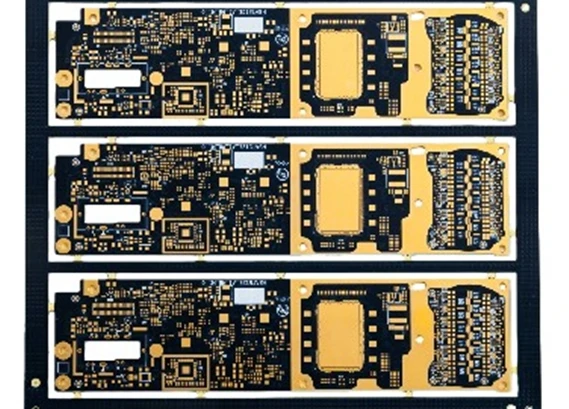
One-stage HDI with embedded ceramic
- Manufacturer’s construction label
- 12-layer, one-stage embedded ceramic board
- Named processes
- ENEPIG, embedded ceramics, sputtering and HDI
Put the ceramic integration, electrical isolation, thermal interface and inspection sections in the drawing package. Request the proposed materials and qualification reports for that section; the catalogue’s process list does not specify a thermal conductivity or insulation rating.
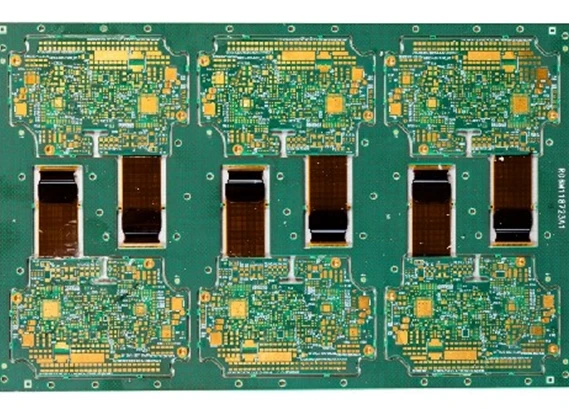
Asymmetric rigid-flex with selective finish
- Stack description
- Asymmetric stackup, “L23 Flex” in the manufacturer’s wording
- Finish description
- Step-plated hard-gold fingers plus ENIG
Request the layer drawing that explains the L2/L3 flex arrangement, rigid-to-flex transition and mechanical clearances. State static installation or repeated movement, assembly temperatures and bend requirements. Gold-finger thickness, finish boundaries and inspection belong in the quotation.
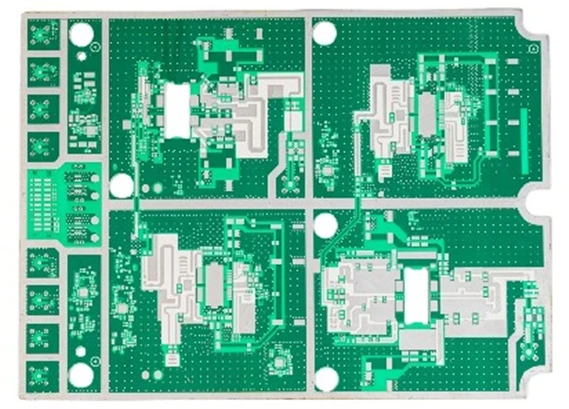
Metal core with embedded copper and depth control
- Material description
- High-frequency material; grade not named
- Named fabrication steps
- Blind-via opening, depth-controlled milling, embedded copper blocks, resin-filled vias and back drilling
This is a multilayer thermal construction. Supply a section drawing for the core, copper blocks, dielectric and cavities, with a depth datum and electrical/thermal acceptance. Define back-drill residual stub separately from the drill-depth tolerance.
The existing MZ-HDI profile represents the batch column.
The official PCB Division sheet has separate site/process and production-stage columns. The MZ-HDI excerpts below explain the existing capability profile; they are not specifications assigned to the three photographed boards above.
Repeat-production envelope
- Maximum layers / finished thickness
- 16 / 2.4 mm
- Inner and outer line / space
- 45 / 45 μm
- Laser-drilled blind via
- 0.060 mm
- Impedance tolerance
- ±8%
Ask the nominated line to release the full stack at the planned quantity. The laser-drilled value is not a finished plated through-hole diameter.
Separate development envelope
- Maximum layers / finished thickness
- 28 / 3.0 mm
- Inner and outer line / space
- 40 / 40 μm
- Laser-drilled blind via
- 0.050 mm
- Impedance tolerance
- ±5%
A successful prototype needs a production-transfer review. Have engineering identify any stack, feature or test changes before assigning a repeat-production order.
The sheet also separates SZ-SML, MZ-MLB, MZ-HLC, MZ rigid-flex/FPC and Jiangsu processes. The company introduction’s newer manufacturing-park claims are not silently substituted into the MZ-HDI batch column. A quote should identify the current applicable revision and process route.
Manufacturing bases and sales contacts have different roles.
The 2026 half-year report identifies BOMIN ELECTRONICS CO., LTD. (博敏电子股份有限公司), Shanghai stock code 603936, and its office at the Chuangxin manufacturing park, No. 3 Bomin Road, Meizhou. The group dates its origins to 1994; the company introduction dates the Meizhou listed-company predecessor to 2005.
The official international sales contact is international@bominelec.com, with the marketing centre at Qianhai, Shenzhen and telephone +86 755 2788 5600. That office is a commercial handoff, not the production address of every order.
Get a named route and an inspection plan.
The 2026 half-year report describes allocating orders across factories according to capacity and product positioning, with selected bottleneck processes sometimes outsourced. For a controlled programme, ask which fabrication steps remain on the approved site, which require external processing, and how change approval and traceability are maintained.
- Choose the constructionAttach the complete stack, section drawing and material grade. For ceramic and metal-core work, include thermal interfaces and isolation; for rigid-flex, include the mechanical use.
- Choose the production stageIdentify prototype, qualification or repeat production, quantities and ramp schedule. Request the named plant/process revision and a clear transfer plan.
- Choose the acceptance evidenceDefine cross-sections, via integrity, electrical tests, finish measurements, traceability and material/change approval. Agree any external processing before release.
Sources behind this profile
Sources individually reviewed on 8 October 2026. Product detail IDs 10004247, 10004246 and 10004245 identify the illustrated constructions. Published process values retain their site and production-stage scope; no independent audit or combined-limit guarantee is implied.
- MANUFACTURER / PRODUCT DETAILSThree automotive product pop-ups and original photographs ↗
- MANUFACTURER / PROCESS SHEETPCB Division: site/process columns, batch and prototype values ↗
- MANUFACTURER / COMPANY & BASESSeparate manufacturing entities and dated project descriptions ↗
- MANUFACTURER / INTERNATIONAL SALESQianhai marketing office and international contact ↗
- ISSUER / IDENTITY & PROCESS OWNERSHIP2026 half-year report, printed pages 5 and 11 (PDF) ↗