In this guide
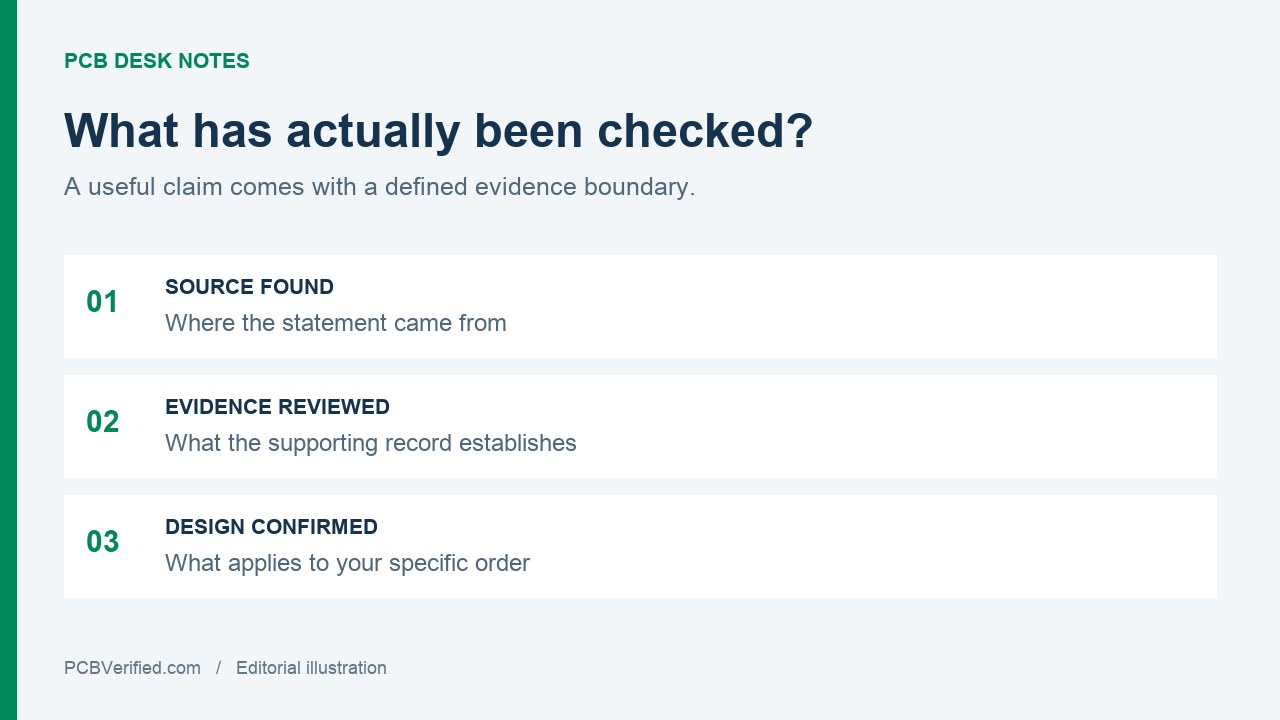
A PCB directory should help you decide what to ask next. It should not turn an unreviewed supplier statement into a guarantee. That is why a plain label — “Not independently checked” — can be more useful than an unexplained green badge.
On PCBVerified, the label describes the evidence we currently hold. It does not mean a factory is dishonest, and it does not mean a listed capability is false. It means that an independent check supporting that particular claim has not been completed. You should not have to guess where our knowledge stops.
A listing is not an audit
There are several different questions behind the word “verified.” Does this business exist? Does the website belong to it? Does a certificate identify the manufacturing entity? Does the named facility own or operate the relevant equipment? Can that production route build your particular design?
An answer to one question is not an answer to all of them. Reading a manufacturer's website can establish where a capability statement came from. It cannot, on its own, establish that a machine is present and operational today, or that an order will stay in-house. A directory entry is a starting point for qualification, not the qualification itself.
Our current public profiles include official-source research. Unless the evidence for a claim has been independently reviewed and its scope recorded, the profile must retain the more limited label. The company name PCBVerified is not a certificate for every company in the directory.
Read the claim and its evidence together
Take a supplier that publishes an E-number beside a UL logo. A useful next step is to search the number in UL's own database, then compare the company identity and the record's scope with the proposed manufacturer and product. UL's printed wiring board search supports both file-number and company searches. A number copied into a brochure is not equivalent to a matching record.
Even a match should not be stretched into a promise about every board, every material or every delivery. Ask which manufacturing site and board construction are covered. Where names differ, request an explanation supported by documentation rather than assuming either fraud or equivalence. Resolve certification questions with the supplier and the relevant certification source before committing to a requirement.
For equipment, separate a sales claim from evidence about a process. An equipment list is useful because it names what can be checked, but a spreadsheet supplied by a seller is still a statement. Ask about machine model, site, process use and the supporting record. An unrelated photograph or a document without a facility identity does not close that gap.
For material traceability, a brand name alone leaves the actual laminate grade and lot unresolved. Put the agreed grade and substitution procedure in your order requirements. Ask which purchase, lot and manufacturing records will connect the material received to the boards delivered. Decide in advance what evidence your quality team needs.
A practical reading order for a factory profile
Start with the legal business and manufacturing location. Note whether the profile identifies a facility or only a sales organization. A trading business is not automatically an unsuitable supplier; undisclosed subcontracting is the procurement issue. You need to know who makes the board and who accepts responsibility for changes.
Next, inspect the origin and date of each technical claim. A current supplier page, an independently checked document and a factory confirmation of your design serve different purposes. Keep those purposes separate in your shortlist. A blank field means that the directory has not established the answer, not that the factory has no capability.
Finally, record what would change your buying decision. If North American product certification is essential, resolve the relevant recognition and construction before ordering. If a particular material is essential, resolve the grade and traceability. If the build is near a manufacturing limit, obtain a design-specific engineering response. A general capability range is not that response.
The useful RFQ question is specific
Instead of asking “Are you verified?”, ask: “Which facility will fabricate this revision, which process steps will be subcontracted, and what evidence can you provide for the stated certification, material and test requirements?”
Then ask the supplier to identify any exceptions in writing. A response such as “we can do everything” does not tell you whether the quotation assumes a different laminate, a relaxed impedance tolerance or an alternative production site. Record the revision, quantities and assumptions alongside the response so that you can compare suppliers on the same basis.
This is a procurement recommendation, not a claim that a particular listed company has failed a check. The purpose is to turn an unknown into a documented question and, eventually, a decision your team can defend.
What would justify a stronger label?
A stronger label needs a defined object, a method, a result and a date. “UL record matched” should identify what was matched. “Equipment reviewed” should identify what evidence was reviewed and what it actually supports. “Material documents reviewed” should not silently expand into a guarantee for all future shipments.
Checks also have a time boundary. Ownership, production routes and materials can change. Preserve the review date and request updated evidence when a change matters to your order. An old check should not acquire a new date merely because the page was edited.
We would rather show an unresolved question than imply an assurance we cannot support. If you hold current evidence or find a mismatch in a profile, send a correction through the platform so that the record can be reviewed. Until that review is complete, “Not independently checked” is the honest state of the information.
Before you shortlist
Use the directory to compare disclosed capabilities and find the questions that deserve attention. Read our evidence policy, keep unresolved items in the RFQ, and confirm the combined manufacturing requirements against the actual design. Trust comes from knowing which assertions have evidence — and which still need it.
Sources & editorial scope
UL printed wiring board database ↗
Reference publisher: ul.com. Original reference retained in the editorial record.
This guide is published by PCBVerified. Confirm design-specific requirements and supporting evidence against the applicable manufacturing profile.
How PCBVerified records evidence →