
In this guide
“Class 3 available” is useful information to ask about. It is not, on its own, a promise that every board a factory ships has been ordered, built and accepted to that class. A directory entry must be read alongside the named standard, product scope, revision and evidence behind the statement.
The procurement task is to turn a general capability claim into an agreed requirement for a specific build. This note explains that boundary without reproducing paid standard tables or assigning a class to a product on behalf of its engineering team.
Class is an application requirement, not a supplier league table
IPC's public performance-class checklist describes Class 2 in terms of dedicated-service products and Class 3 in terms of high-performance or harsh-environment products where continued performance is critical. These broad descriptions support a conversation about intended service; they are not a substitute for the applicable specification.
Do not rank a supplier as good or bad simply because it advertises one class. Have the responsible engineering or quality team specify the appropriate requirements for the product. Then ask the manufacturer to confirm that it can meet them for the proposed construction and order.
Avoid choosing by industry label alone. A phrase such as “industrial,” “medical” or “automotive” does not communicate the complete fabrication and acceptance requirements. The purchase documentation needs to do that work.
Identify which standard and which deliverable
IPC distinguishes the qualification and performance specification for rigid printed boards, IPC-6012, from the visual acceptability guidance in IPC-A-600. Populated electronic assemblies have a different scope, including IPC-A-610 and soldering requirements addressed by J-STD-001. A claim about assembly acceptance should not be copied into a bare-board field as if the two were equivalent.
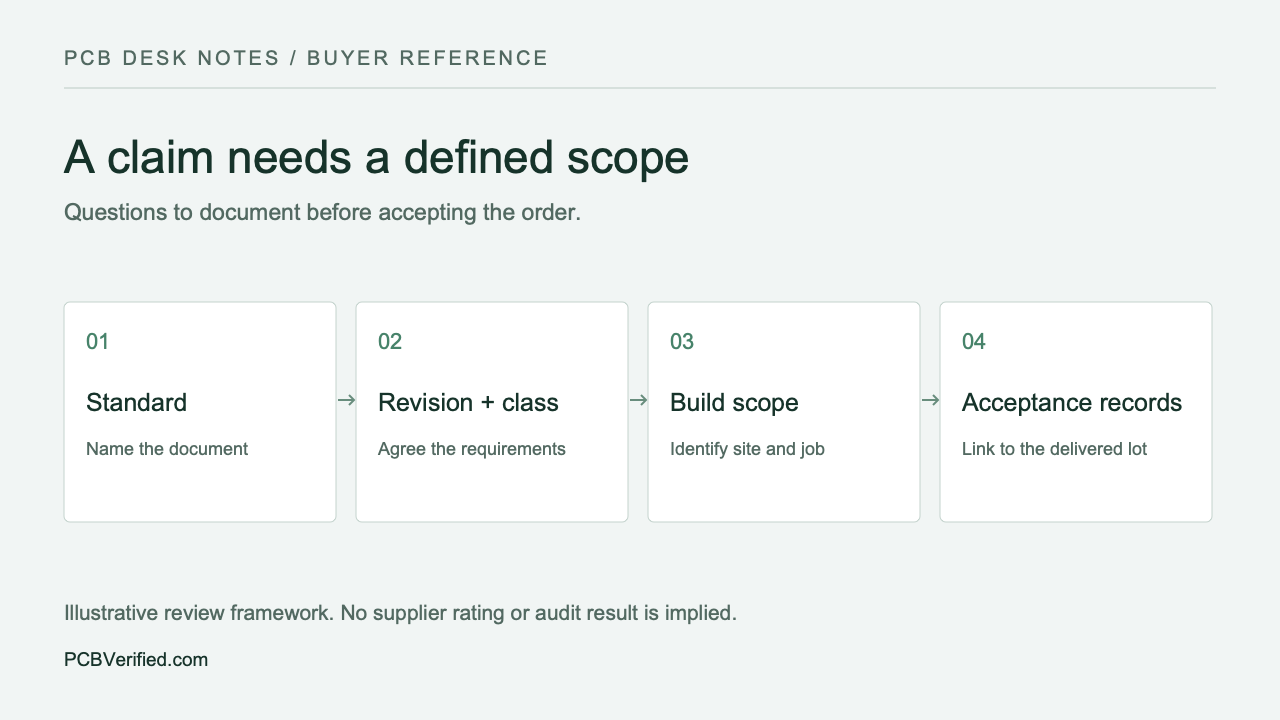
Write down the deliverable first. Is the quotation for rigid bare boards, another board technology, assembly, or a combined service? Identify the applicable documents, agreed revisions and any addenda with the people responsible for the design and quality plan.
This article deliberately avoids numeric acceptance limits. Use the authorized version of the applicable standard for those decisions, including its definitions, exceptions and agreed requirements. A short directory description cannot safely replace that context.
Ask what evidence supports the profile statement
Our recommended profile review distinguishes three things: a supplier's published capability claim, evidence reviewed by the directory, and order-specific acceptance records. A statement can be accurately reported while the supporting evidence remains unreviewed.
Ask whether the claim applies to the named manufacturing site, process and product type. If evidence is offered, identify what it is: a training credential, a process qualification, an audit record, a sample inspection package or an order conformity statement. Record its scope and date instead of treating the presence of an IPC logo as the answer.
For purchasing, agree the inspection and test records your order will require, who will review them and how records will identify the delivered lot. A sample report can explain the reporting format; it does not establish that your future order has passed inspection.
Translate the class into a reviewable order
Include the class and applicable standard revision in the fabrication or assembly requirements, as appropriate. Ask the supplier to acknowledge those requirements explicitly and list any exceptions before accepting the order. Keep that acknowledgement with the controlled file revision and quotation.
Discuss how nonconformities, proposed repairs and deviations will be handled under the agreed requirements. Identify who can approve a change and whether shipment must wait for that decision. Do not leave the disposition of an exception hidden inside a generic statement that the factory will follow its normal process.
The goal is not to invent an additional certification scheme. It is to prevent two parties from using the same short label while referring to different products, documents or acceptance arrangements.
Compare two profile statements carefully
Consider two hypothetical directory entries. One says “IPC Class 3” with no named standard or evidence. Another says that the supplier reports rigid-board manufacture to a named IPC performance specification, while independent review is pending. The second is more informative about what is known; neither establishes acceptance of your order.
If records have been reviewed, a useful entry states the reviewed scope, date and remaining limits. It should not imply that a training certificate guarantees product conformity or that one reviewed job covers every material and construction the supplier may offer.
Put this question in the RFQ
“Please acknowledge the applicable standard, revision, class and any addenda for this exact deliverable. Confirm the manufacturing site and construction covered, identify exceptions, and state which inspection, test and conformity records will accompany this production lot.”
Use the response to complete the purchasing requirements. A PCBVerified profile helps you find the question and locate its evidence status. The actual manufacturing promise belongs in the accepted order and its supporting records.
Sources & editorial scope
IPC public performance-class checklist ↗
Reference publisher: electronics.org. Original reference retained in the editorial record.
This guide is published by PCBVerified. Confirm design-specific requirements and supporting evidence against the applicable manufacturing profile.
How PCBVerified records evidence →